Showing posts with label Facebook Advertising Agency | Facebook Marketing Company. Show all posts

Tuesday, 23 April 2019

How To Apply Brand Consistency Into Your Website Design

It is not possible for a brand to exist fully offline in today’s era of the 21st century. Yes, a business can operate offline like a restaurant or a grocery store, but even these categories of commerce need an online venue such as a website. Why? Because if you’re not online then people searching for companies which operate in your area, E.G., website design, will enter keywords relevant to your business on search engines. For example, brand identity design Dubai. So, if you don’t have a website, social media page, or even a social media channel, it’s unlikely that your online or semi-online business will be discovered by new customers.

But even though social media’s popularity has made pages and channels a necessity for firms, the website of a business should be still be given the utmost priority. This is because when people visit your website, they are in a way, visiting your company offline and reviewing your products from the shelves. Case studies show that 88% of website viewers will not re-evaluate a website if their initial experience was negative. Though these statistics seem to overwhelming for the layman, it maximises the vitality of design in developing websites.

Finally, you have decided to launch your start-up business. You have purchased a domain, illustrated a catchy commercial tagline, and designed the layout of the website outlining who you are and what you sell. Now it’s time to focus on how to retain the customers’ attention and keep them coming back for more, I.E., enhance consumer loyalty in the long run. This ultimately leads to developing a website with persistency brand-wise. Why is this necessary? Because a brand is not just a name like Google or Amazon though the title of your company definitely falls under the term, brand. It is not a slogan like Amazon’s And you’re done but a tagline is a subcategory of brand, and it is not just a memorable logo like that of Apple’s, though again this piece of art is a part of the brand as well.

A brand is a narrative which connects your firm with your customer base. If the design of your website correlates with this tale then your business will be a seen as more credible and relevant. This is the reason why mixing brand persistency with design is crucial for companies, as it makes the firm more famous amongst its buyers.

Typography, colouring, layout, etc., all complement the design of your website. But if these sections are overemphasized, coloured wrongly, or the wrong fonts are finalised, then brand consistency will not be built properly. And you’ll lose customers instead of gaining new followers.

You are in luck as we have listed a few suggestions below which will help you make the best out of the correlation between brand consistency and website design.

Situate your logo at the correct angle

A firm’s logo is like a book’s cover—the content shouldn’t be judged by the design, but it usually is. Both sensitivity and professionalism make up the design of the world’s most recognisable logos. But equally important is where your logo will be situated on your website.

Be clear and concise on where your logo will be situated. One suggestion is placing it on the top left as most of the languages used across the globe are read from left to right. Thus, by situating the logo on the top left, it will be the first piece of information that enters the minds of your consumers.

Of course, you could opt for something new and place your logo anywhere else rather than the top left segment. This is particularly true if the brand itself is experimental in nature. Uniqueness is a crucial aspect, but legibility should also be considered. Firms which combine both the afore-mentioned points will come out with the most useful logo placement strategy in the long run.

Persistency is key

Just like the word consistency in brand consistency, it is suggested that all elements of a website’s design correlate persistently with each other. This is because people will associate the beautiful design of your website, the easy-to-use interface of your company’s site, etc., with the comprehensive performance of your business.

In alternative terms, how you present your business on the web reflects how your company is viewed off the internet. And if visitors to your site like your online portal then they might even take a chance at your offline venues as well.

Use proper colouring schemes

Notice that majority of the famous company’s logos, such as Google and McDonald’s, use logos which comprise of primary colours. You should opt to utilise the same strategy. This is because primary colours are the most easiest for viewers to identify with. But the colouring strategy should not be applied solely to your logo. Each colour also emits a particular essence. E.G., the blue coloured layout adopted by both Facebook and Twitter is known to put visitors as ease as blue is associated with a calming sensation. So, by choosing the right colouring scheme for your typography (headlines, article content, etc.), backdrop images, and overall layout, visitors will become captivated by the beautiful and colourful design of your website.

White space should not be overlooked

The need to fill up every crevice of the website’s layout is tempting, but doing so might backfire on the designing strategy. So, by integrating white space into your design plan, customer retention as well as rates of comprehension would go up by 20%.

Fonts should be simple

Typography should be given as much significance as the colouring scheme on your website. Although, there are thousands of font designs available for usage, utilising a variety of them might turn off visitors from reading the content on your company’s website. Simply choose one or two fonts that most accurately define your company’s mission statement. Whichever type of fonts you end up choosing (serif, sans-serif, etc.) remember that the most crucial element of picking typography is that the fonts need to be decipherable to the readers.

The post How To Apply Brand Consistency Into Your Website Design appeared first on Facebook Advertising Agency | Facebook Marketing Company.


from
https://voymedia.com/how-to-apply-brand-consistency-into-your-website-design/

Monday, 22 April 2019

55 Must-Use Newsletter Topics

If you’ve built an email list, the next thing to do is prepare and send your newsletters. From informational pieces about your business to fun photos of your recent public event, there are many newsletter topics to choose from.  

Email Newsletter Facts

Before diving into newsletter topics you can use for your business, let’s review a few interesting email newsletter facts:

  • Email is the 3rd most influential source of information for B2B customers. What was 1st and 2nd? Colleague recommends and industry-specific thought leaders.
  • When it comes to revenue generation, 59% of B2B marketers say email is their most effective channel.
  • Tuesday is the best day of the week to send an email.
  • Tailoring content to segmented users on your email list as allowed some marketers to achieve a 760% increase in email revenue.
  • One in five (19%) of consumers said they read every email newsletter they receive just to see if something’s on offer (Forrester Research “North American Technographics Survey”, 2014).

With email newsletters, you can feel confident that your message doesn’t get lost. If you think about it, if someone offered you their email to send them a newsletter, you have exclusive access to their personal space. In between email messages from mom and updates from colleagues, could be your email newsletter just waiting to be opened.

So, to ensure that your next newsletter captures the interests of your subscribers, here are some ideas to get you inspired.

Newsletter Topics You Can Use

  1. Information blog posts that offer advice, support, and value to your email list;
  2. Invitation to an upcoming event, tradeshow, workshop, or festival which you are hosting, participating, attending, or sponsoring;
  3. Featured articles and blog posts from guest authors and influencers;
  4. Ask readers to take a survey or poll in exchange for a coupon or discount;
  5. Share FAQs about your products, services, or business;
  6. Send a product or service demo;
  7. Celebrate a milestone, anniversary, or special event at your business (this could be a team member’s birthday or the business itself);
  8. Feature a list of helpful, insider tips or DIY info related to your products, services, or industry;
  9. Send access to the podcast provided by your business;
  10. Make a summary statement about the donations or charitable organizations you support and share a story as to why;
  11. Use customer testimonials, feedback, and mentions;
  12. Provide an annual report, company summary, or message from the CEO that captures the success, growth, and impact of your business;
  13. Create a roundup of your most popular products, blog posts, videos, infographics, and any other content over the past month or year;
  14. Share industry-related content (i.e. articles, videos, infographics, etc.) that you came across;
  15. Send a gift guide during special holidays;
  16. Write stories about new employees and team members at your business;
  17. Mention an upcoming offer, promotion, sale, or early bird discount;
  18. Tell your company’s story;
  19. Give your list a behind-the-scenes glimpse of your business and customers (i.e. send photos);
  20. Feature any awards you won or achievement your attempting to win.
  21. Share the apps and tools you find useful;
  22. Send a curated list of customer photos — use photos where customers are happy, using or purchasing from your business, or an event they recently attended;
  23. Invite readers to signup to a customer loyalty or rewards program;
  24. Showcase a contest or exclusive giveaway;
  25. Announce the winner of your content or giveaway;
  26. Feature all the times you were mentioned in the press or other news outlets;
  27. Give them a sneak peek of upcoming products, services, or features;
  28. Invite them to go to an upcoming live stream or webinar you’re hosting;
  29. Make an announcement about a new product or service you just released;
  30. Release relevant and weird statistics, studies, or surveys about your business;
  31. Send a new Pinterest board you created;
  32. Discuss breaking trends or news related to your industry;
  33. Announce your newly redesigned website or blog;
  34. Send a list of do’s and don’ts about your industry;
  35. Send reminders to save-the-date for upcoming deadlines, registrations date, and so on;
  36. Create holiday newsletters with featured content and relevant material;
  37. Share a review you wrote online;
  38. Share a review written about your business;
  39. Comment on local news or political affairs that affect your community or business;
  40. Send your latest or most popular Instagram posts for the month;
  41. Share free resources, such as a white paper or downloadable guide;
  42. Encourage your list to follow your business on the social media sites your business uses;
  43. Send motivational or funny quotes;
  44. Share information about a crowdfunding campaign you are running or supporting;
  45. Release information about a new strategic partnership or business you are working with;
  46. Send job information if there are any open positions at your business;
  47. Share videos and pictures of a recent challenge you participated in (such as the Ice Bucket Challenge) or encourage your list to participate in a new challenge;
  48. Create a Staff or Employee Picks for your products or services;
  49. Highlight your mobile app’s features and functionality;
  50. Feature an interview with a client, customer, employee, vendor, or another industry-related expert;
  51. Request readers to leave feedback on various local listings, Facebook pages, and other places your business engages with online;
  52. Feature best selling products over the past month or share a story of a recent product that sold-out and the craze that made it so popular;
  53. Seasonal greetings;
  54. Share customer support or service information;
  55. Send a spontaneous “Thank You” to your list using a fun GIF, video, or message.

Real Examples of Newsletters

  1. Harvard Business Review

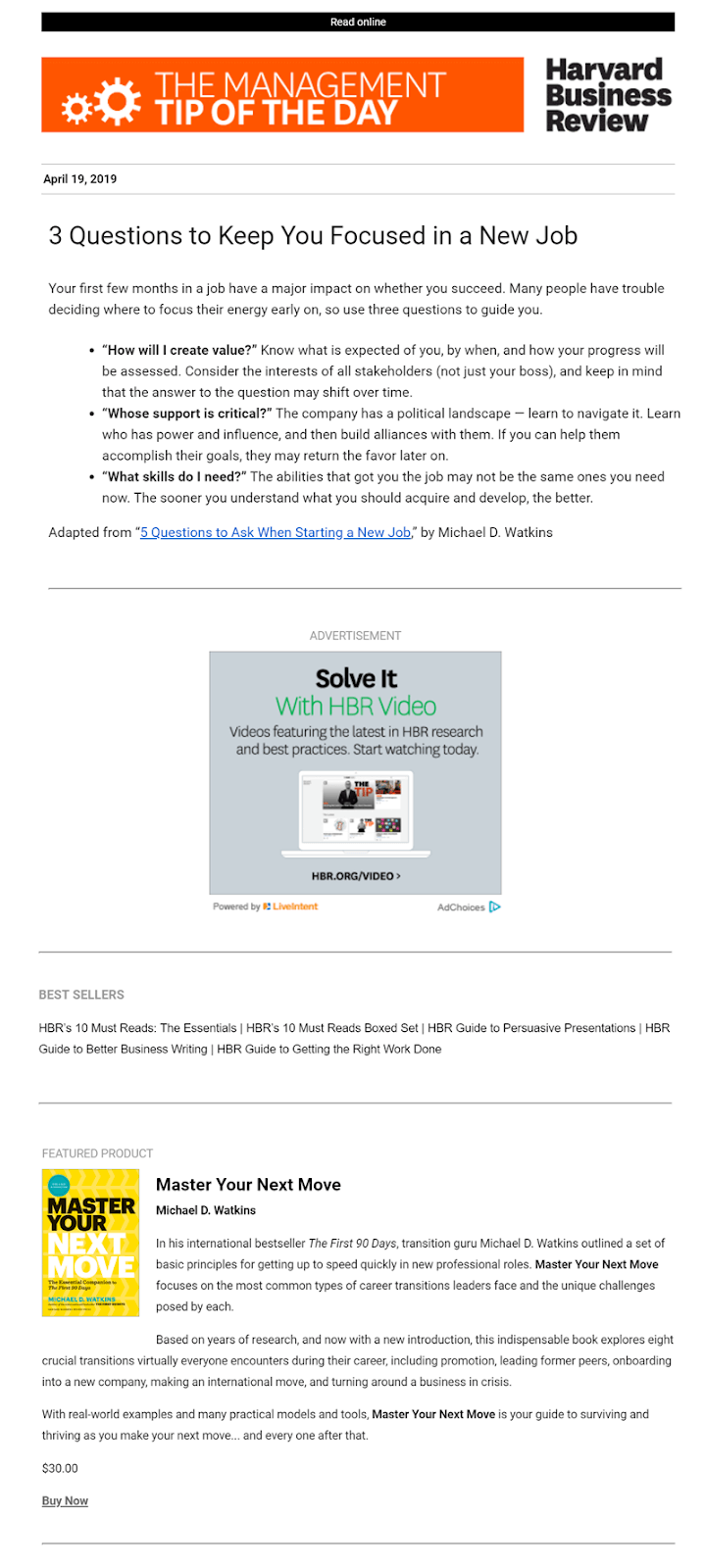
Harvard Business Review sends a daily newsletter which contains the Management Tips of the Day. The content ranges from advice for executives, marketing teams, and other business tips to help a range of different situations.

The tips they introduce are always top quality and condensed versions of an already published article online. Below the tips, you can see they include links to featured products, advertisements, and best sellers.


  1. SerpStat

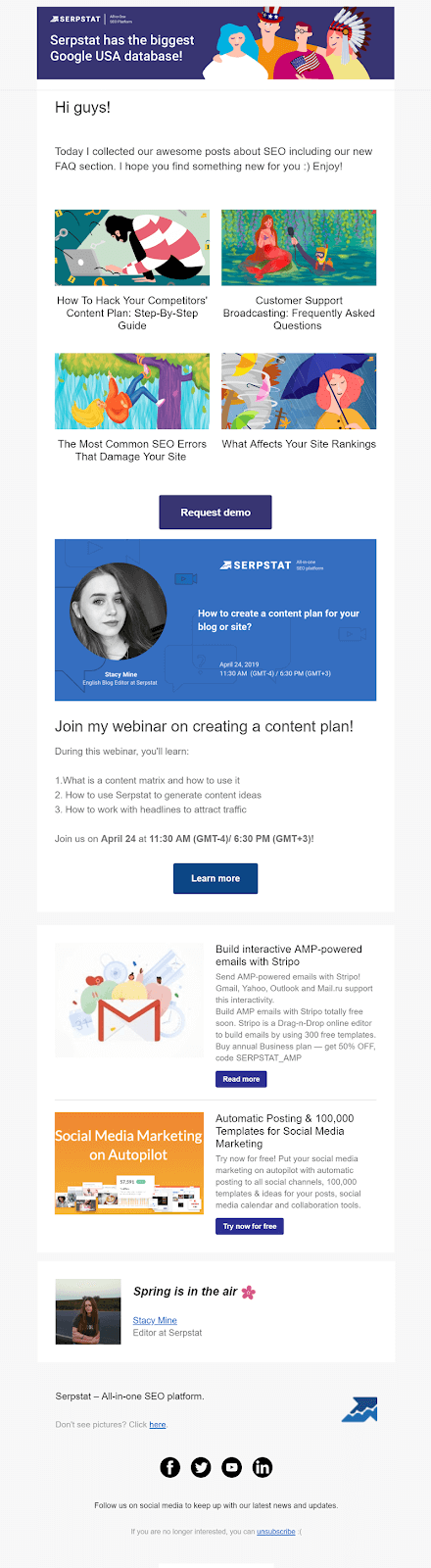
This newsletter from SerpStat offers a hack to create a content plan that outperforms the competition. They start by packing it full of value-focused content featuring their new FAQ section on the website. Below that, they invite readers to try a demo of the platform.

Later in the email, they include an invitation to join a webinar related to the topic of the newsletter. Then, they wrap it up with a few more articles from their blog and the signature. Very effective!

  1. MailJet

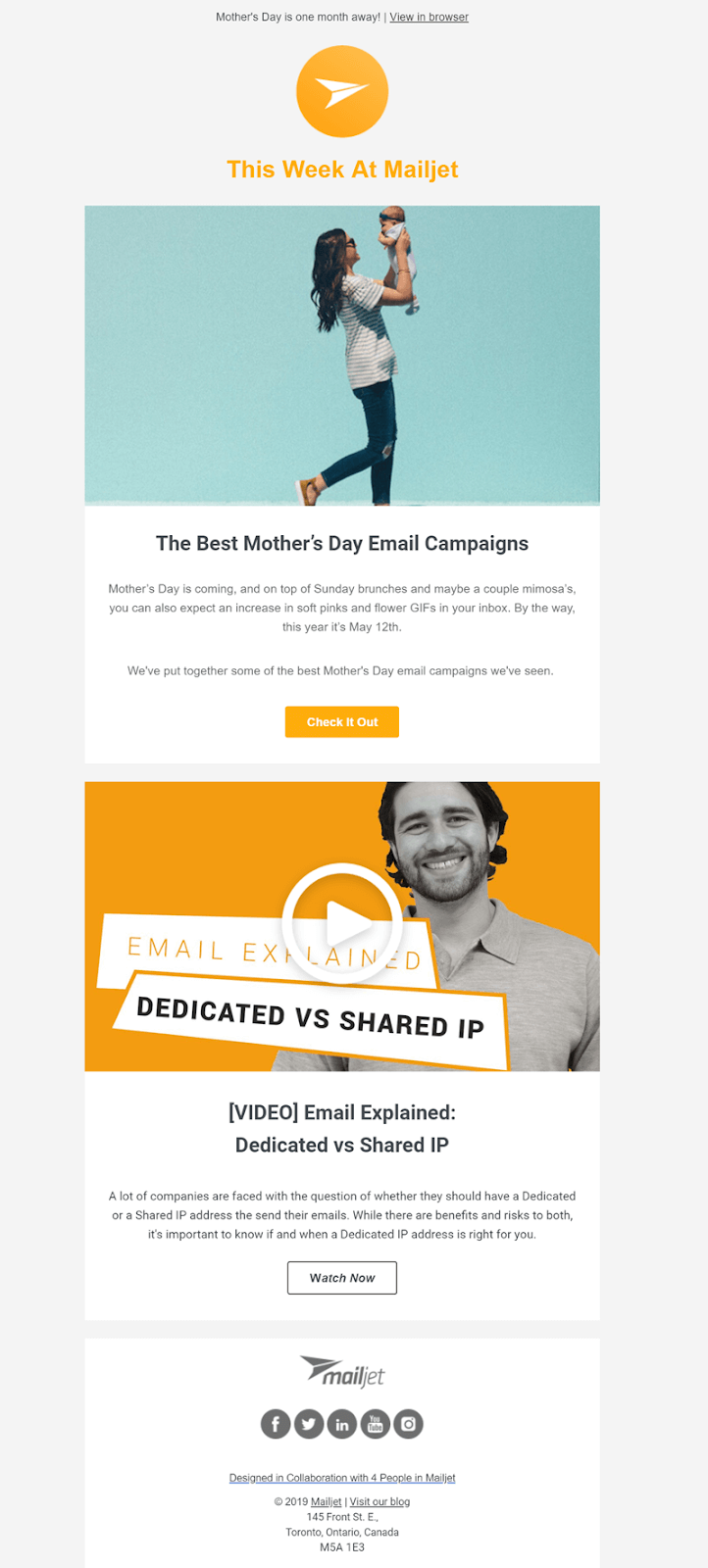
MailJet stays up to date with special occasions with this email newsletter dedicated to Mother’s day. They share an article with their list that helps them plan an email. Here’s the link to that post, in case you want to read it.

Below the article, they also include an informational video to educate their list about some key features of their industry. This is a simple approach to keeping people engaged and up-to-date with their service. 

The post 55 Must-Use Newsletter Topics appeared first on Facebook Advertising Agency | Facebook Marketing Company.


from
https://voymedia.com/55-must-use-newsletter-topics/

How to Retain Customers

The best way to grow your business, revenue, and sales is to not lose your customers.

In 2017, Forbes published an article stating that $62 billion in business was lost due to poor customer service. For the average business, it was also reported that 10 to 25% of customers are lost every year.

Perhaps there are some new customers who replace the old, however, the potential for repeat business will have your business spending time and money attracting more.

In today’s post, let’s discuss how to retain customers.

Why is Customer Retention Important?

Customer retention is the activities and actions your business must take to increase the number of repeat customers as well as to increase the profitability of existing customers.

If left ignored, you may want to consider how much you are spending on customer attribution. Customer attribution includes all marketing, advertising, and other related costs used to attract and convert customers to your business.

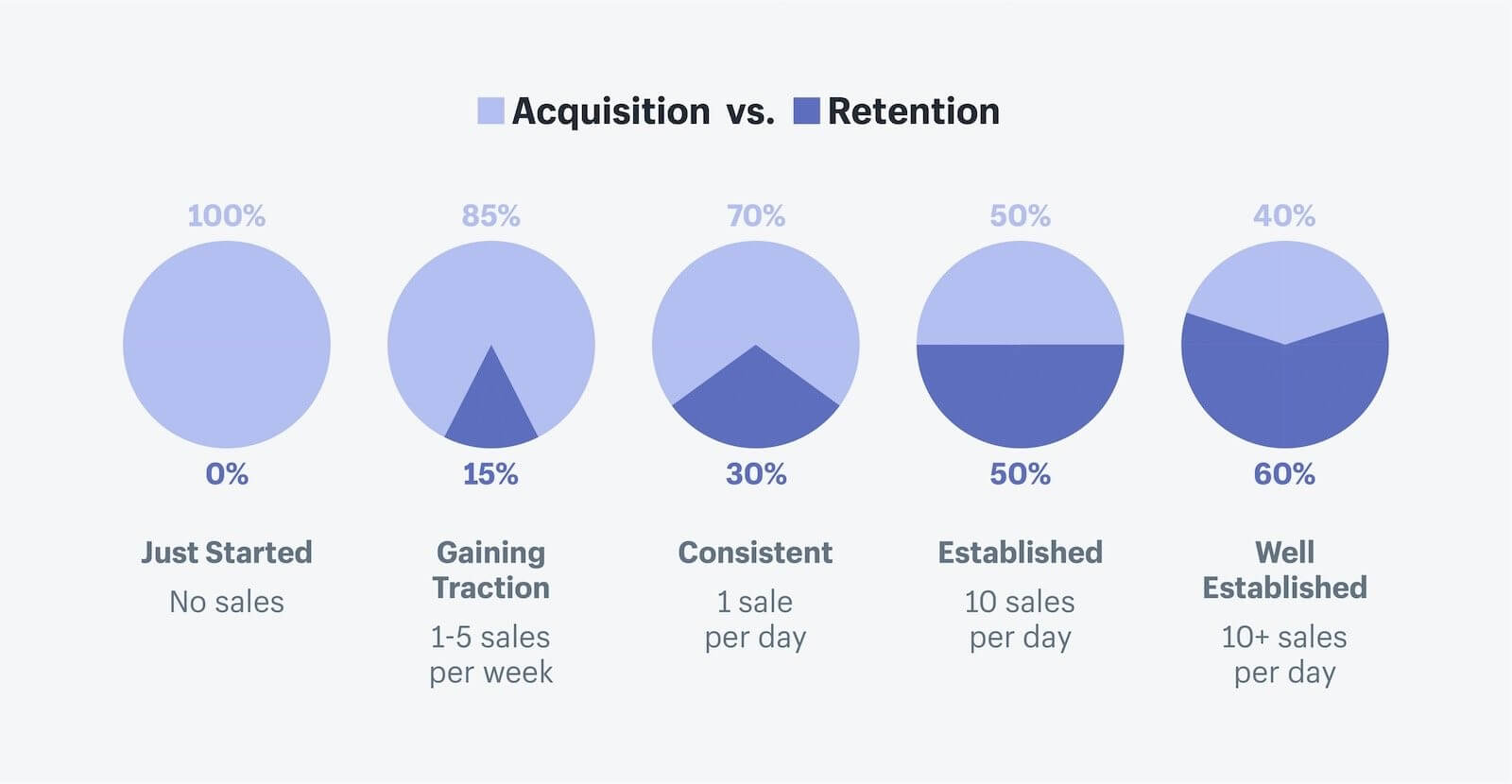
Image Source

Even though customer acquisition is the fundamental approach to building your business, having an effective customer retention strategy is going to maximize your revenue over time.

Here are a few ideas to help you retain customers.

  1. Minimize Attrition

Many businesses spend significant time, effort, and money building the initial customer relationship. However, very few use that same time, effort, and money to measure or recognize how and when their customers become inactive.

If relationships are left unattended, customers may start to lose interest, consider competitors, and abandon your business altogether. If you can tap into the reasons why customers are leaving your business, you can focus on delivering longer customer experiences that drive long-term revenue gains.

  1. Implement Support Systems

You need a comprehensive support system. This could be a FAQs page, product manuals, educational video series, live chats on websites, and more. If your customers don’t have easy-to-access support whenever a problem arises or a question comes to mind, they’re probably going to get out.

Be sure to establish your support systems from the get-go. You should have a clear idea as to what the objections and questions your customer might have. These can be addressed in advance on your website.

Meanwhile, for spur-of-the-moment problems that occur unnoticed, set up a support plan that addresses the issue and responds as promptly as possible. In these circumstances, over-communicate that you’re going to get back to your customer to help them soon.

  1. Survey Your Customers

Tap into your customer base and figure out their thoughts and feelings for what you offer. Send them a survey to capture their feedback and identify at-risk customers before they leave.

As Philip Libin, CEO of Evernote, says:

“Complaints are great… they tell us where our product or overall experience is failing.”

Use the information from your survey to assign sales or support teams to follow up with those sending poor ratings. Send emails letting them know of coming updates, offer a promo code or discount, or send them a personalized note that lets them know you care.

If you see positive ratings in your survey, reach out to those customers too. Encourage them to join your VIP programs or offer them exclusive discounts.

Create surveys that are between 1 to 3 questions, ideally embedded in an email, to minimize customers from wasting time bouncing to different places to submit their forms.  

  1. Measure Lifetime Value

Do you know the average amount of money a customer will spend at your business? Customer lifetime values is a metric you can use to understand when, where, and why customers interact, engage, and spend with your business.

To calculate your lifetime value, take the average order total multiplied by the average number of purchases in a year multiplied by average retention in years.

This will give an average lifetime value of your customers based on real data. It offers you a data point you can use for customer segmentation, targeting customers to extend their lifetime, and strategies to implement promotional efforts.

  1. Create Unexpected Customer Perks

How can you surprise your customers with gifts and perks they didn’t see coming? If you want to build loyalty and delight, this is the way to do it.

For example, if you are a Sephora Beauty Insider, you can receive a free gift on your birthday. These customers get to choose between a skincare package, a beauty makeup bundle or, for those in the upper subscription levels, the choice of 250 bonus points.

When you are capturing your customer data, you can request their birthdays and implement this into a CRM program to automate the process of sending birthday surprises.

Other ideas to surprise your customers:

  • After a customer buys 3 pairs of shoes from their shop, send them a complimentary pair of funky, cool socks.
  • If a customer spends $500+ with your business, send them a hand-written note or a postcard from you or your sales team.

These types of unexpected displays of appreciation o a long way to build stronger customer relationships and positive customer experience while minimizing the rate of attrition.

Quick Tip: Hex built a thriving business by sending over 13,000 thank you letters to their customers. Try sending thank you and goodbye letters to your customers.

Conclusion

Keeping existing customers is a lot easier than attracting new customer to your business. By now, you should have some new ideas to improve your customer loyalty and to encourage soon-to-disappear customers to reengage with your products, services, and offers.

Customer retention is a critical component for the sustainability and profitability of your business. It helps keep you engaged with your customer base and provides you with raw data to extend customer lifetime value.

Focus on finding specific reasons why customers are leaving your business and use this as a starting point to improve relationships. You can social media marketing, advertisements, customer loyalty programs, and more to make a better customer experience for all.

Question: What customer retention strategies have you used that worked with your business?

The post How to Retain Customers appeared first on Facebook Advertising Agency | Facebook Marketing Company.


from
https://voymedia.com/how-to-retain-customers/

How to Drive Traffic to Your Website

If you want to increase your online sales, you must know how to drive traffic to your website. There are many ways to increase traffic to your website, and in today’s post, we’re going to look at XX of them.

Where to Start with Driving Traffic to Your Website

Let’s say you just finished published your website. It’s brand new, fresh out-of-the-box. The obvious thing to do now is to generate traffic to your website, but, you don’t know where to start.

Well, before you spend any time testing strategies to grow your traffic, you need to make sure your website is set up in a way that resonates with your audience. Here are a few articles curated for you to ensure your traffic achieves maximum conversions:

If you feel prepared to start driving traffic to your start and confident you’ll achieve conversions, let’s dive into the strategies to make it happen.

  1. Create Share-worthy Content

New websites rarely start acquiring thousands of viewers a day without any content. If you have a blog, focus on creating share-worthy content with a slight focus on going viral.

First, scan your industry. What are other websites blogging about? What are the trending topics in your niche? What are the pain points your customers want solved?

Then, start producing 500-word advice posts followed by in-depth 5000-word step-by-step guideposts that genuinely help people. People will notice, especially if you dedicate time and attention on quality content.

Quick Tip: Fill up your blog with valuable list posts and information articles such as Top 5 Ways to Do XYZ, or 17 Best Strategies for ABC.

  1. Capitalize on SEO

Search Engine Optimization (SEO) is a fundamental strategy to drive free traffic to your website from search engines like Google, Yahoo, and Bing.

A simple way to understand SEO is this: SEO is a measurable, repeatable process that sends signals to search engines telling them your pages are worth showing. The information you need to send these signals to search engines are:

  • Keywords. These are words and phrases people are using on search engines. Your posts and your pages should include them strategically without disrupting the quality of your content.
    Click here to learn about Keyword Research to Boost Sales and Traffic.
  • Metadata. This is the “behind-the-scenes” information that tells search engines about the content on your posts and pages. This includes titles, meta descriptions, image ALT, and more.
  • Site speed. Changes in Google’s algorithms are geared toward quality, fast-loading web pages.

SEO is a must-do if you want to drive more traffic to your website. While this post introduces you to the idea, you can find more information on creating SEO content here.

  1. Build An Email List

Are you using a lead magnet on your website? This is a strategic move to capture a visitor’s email and encourage them to return to your website down the road.

Add a sign up to your posts, use a pop-up after visitors stay 10-seconds or more, provide a newsletter with value-focused content. Then, consider using an email marketing platform like Klaviyo to send automated emails to bring your list back to your website.

  1. Guest Posting

This is a broad topic with quite a few tactics to experiment with. The first is to find related bloggers in your niche and reaching out to see if they’ll accept a guest post from you. There may be some trial and error in getting your pitch together and you should expect rejections or no replies at all. However, once you start building your connections and a network of guest posts, you can get significant links back to your website.

Alternatively, you can also try posting on websites like Medium or Quora. Both platforms have a large user base actively posting and engaging. With Quora, you can answer relevant questions in your post and include a link back to your website or specific pages. The more helpful you are, the more engagement you’ll have, and the more traffic you can drive to your website.

  1. Social Media

You should be familiar with all the popular social channels: Facebook, Instagram, Twitter, LinkedIn. These are active sources of traffic for your website.

However, the strategies you use here must go beyond sharing the content from your website to your social channel. It’s not enough to click share and expect traffic to come flooding to your website.

Instead, you have to be equally active in your efforts as the people engaging on these platforms. This means, you must participate in conversations. Reach out and connect with other pages, people, and influencers. Add comments and comment back.

Social media was designed for people to be social. And, being social requires interactions from both sides.

  1. Paid Advertisements

If you want to get traffic the fast way, pay for it.

You can use Facebook and Instagram ads to target specific audiences relevant to your website. Once you establish your budget and the creative content for the ads, you can run campaigns to drive traffic to your website.

Some businesses use paid ads not only to gain more traffic, but also to earn more profit. Depending on the ads being used, if it resonates with an audience you can expect to see reasonable results. Whereas other businesses spend hundreds to thousands on paid ads and get little to no return.

If you’d like to get some advice or help with your Facebook or Instagram marketing, get in touch.  

  1. Use Analytics

In all your efforts to drive traffic to your website, install an analytics program like Google Analytics. Use analytics to observe visitor behavior, traffic sources, and other key information to improve your efforts.

If you use Google’s keyword report, you can increase your website’s traffic by using the right keywords in your content. Focus on the top 10 keywords and continue to track performance in the coming months.

Finally, check to see which channels drive the most visitors to your website. Are you gaining the most traffic from organic search results? Social media platforms? Website backlinks? Find the areas where you are succeeding and develop new actions to further enhance the results.

Want to learn more about paid traffic and organic search? Give this a read!

The post How to Drive Traffic to Your Website appeared first on Facebook Advertising Agency | Facebook Marketing Company.


from
https://voymedia.com/how-to-drive-traffic-to-your-website/

How to Create a Slogan

What is a slogan?

A slogan is a witty, punny, or memorable catchphrase that represents a product or company. Great slogans are crafted with care while communicating the benefits you want consumers to associate with your business.


Why You Need a Slogan

Slogans help to improve brand recall and make your brand stand out. Consider them an opportunity to make a lasting impression on your audience. It connects them with who you are, what you do, and what you intend to achieve. Powerful slogans can do the following:

  • Reveal product/service benefits
  • Connect with emotion
  • Offer a promise or commitment
  • Be funny
  • Create a strong memory of your brand

Take a look at FedEx’s slogan: “When it absolutely, positively has to be there overnight.”

Although this slogan is fairly long, it does a good job of being memorable. It tells you the benefit of choosing FedEx and makes a strong statement about their business: they’re fast and reliable.

Slogans like, “We deliver” doesn’t say anything meaningful and is too vague. Why would anyone choose a shipping service with that slogan when FedEx gets it there absolutely, positively overnight?

Slogan vs. Tagline

Slogans and taglines are often used interchangeably, however, they serve two completely different purposes.  Both identify a business, brand, product, or service for what they do. The difference is how it positions a company in their industry.

  • A slogan captures a company’s mission, strategy, and how they help their customers. Slogans tend to be longer than taglines.
  • A tagline is a catchy phrase that evokes emotion and imagery about your business or brand. Taglines are memorable and easily shareable.

Taglines are typically used with a company’s logo and published throughout advertisements. The ultimate goal is to drive more brand awareness. In contrast, slogans encompass a company’s core values and promises which can be used as a company grows and evolves.

You may not need both a slogan and a tagline. But as you develop your brand, you might find a new slogan or catchphrase to promote during a campaign.

Catchy Slogans Used Through Time

  1. iThink therefore iMac. 𑁋 Apple
  2. Reach out and touch someone. 𑁋 AT&T
  3. The Citi never sleeps. 𑁋 Citi Bank
  4. A diamond is forever. 𑁋 De Beers
  5. Shave Time. Shave Money. 𑁋 Dollar Shave Club
  6. The happiest place on Earth. 𑁋 Disneyland
  7. Buy it. Sell it. Love it. 𑁋 eBay
  8. Keeps going and going and going. 𑁋 Energizer
  9. We live to deliver. 𑁋 FedEx
  10. Imagination at work. 𑁋 General Electric
  11. Don’t be evil. 𑁋 Google
  12. Leave the driving to us. 𑁋 Greyhound
  13. Pleasure is the path to joy. 𑁋 Hӓagen-Dazs
  14. American by birth. Rebel by choice. 𑁋 Harley Davidson
  15. Solutions for a small planet. 𑁋 IBM
  16. Born to perform. 𑁋 Jaguar
  17. Twist, Lick, Dunk. 𑁋 Oreo
  18. Because you’re worth it. 𑁋 L’Oréal
  19. The relentless pursuit of perfection. 𑁋 Lexus
  20. Good to the last drop. 𑁋 Maxwell House
  21. I’m lovin’ it. 𑁋 McDonalds
  22. Got milk? 𑁋 National Milk Producers Board
  23. Just do it. 𑁋 Nike
  24. At the heart of the image. 𑁋 Nikon
  25. Live in your world. Play in ours. 𑁋 PlayStation
  26. I am what I am. 𑁋 Reebok
  27. Taste the rainbow. 𑁋 Skittles
  28. Obey your thirst. 𑁋 Sprite
  29. Eat fresh. 𑁋 Subway
  30. Outwit. Outlast. Out Play. 𑁋 Survivor TV series
  31. Be all that you can be. 𑁋 U.S. Army
  32. It’s everything you want to be. 𑁋 Visa
  33. Think small. 𑁋 Volkswagen

Tips to Create a Slogan

  • Use these 5-memory techniques.
  1. Rhyme: words that have the same sound.
    The best part of waking up is Folgers’ in a cup. 𑁋Folgers
  2. Alliteration: Words that start with the same letter.
    The daily diary of the American dream. 𑁋 Wall Street Journal
  3. Repetition: Uses a repeating word or concept.
    Have a break, have a KitKat. 𑁋 KitKat
  4. Reversal: phrases that include opposite meanings.
    Our food is fresh. Our customers are spoiled. 𑁋 FreshDirect
  5. Double-entendre: Words or phrases that are open to two interpretations, one of which is risqué, sexual, or indecent.
    Pleasing people all over the world. 𑁋 Holiday Inn
  • Highlight a key benefit. The purpose of a slogan is to differentiate your product or brand from competitors. It should touch on the general mission of your business and express the unique benefits it offers to consumers. Slogans can be the first point of contact with potential buyers, so it is absolutely necessary to emphasize your business worth. Isolate and focus on one key area if your business and incorporate that into a slogan.
  • Keep it simple. A slogan is only effective if an audience can understand it. Focus on using short sentences and short words because you only have a few short seconds to capture your audience’s attention.
  • Be honest. Honesty is important and valued by consumers. If you can’t deliver a statement your business won’t uphold, don’t use it. Statements like, “the best” or “#1 at what we do” is difficult to prove and rarely believed. So, find a clever way to express your business perks.

Steps to Create a Slogan

Step 1: Assemble Your Team

Gather your team for a brainstorming session and find ideas that reflects what your business does and the message you want to achieve.

Step 2: Define Your Values

With your team, define or review the core values of your business. Use this as a starting point to find segments of your business to create your slogan.

Step 3: Focus Your Message

Find one key area of your business you want to focus on. What features or benefits can be emphasized to make your business stand out from the competition?

Step 4: Assemble Your Team

Gather your team for a brainstorming session and find ideas that reflect what your business does and the message you want to achieve.

Step 5: Write Your Slogan(s)

Start writing. Use all your ideas to create variations of words and phrases. Take a moment away from the writing and return to it with a fresh mind. Filter the slogans that resonate with your business and fine tune if necessary.

—

As you create your slogan, focus less on the “content” of the message and more on the “memorability” of it. Without memorability, your slogan is unlikely to accomplish much. That is the key to a strong online brand.

The post How to Create a Slogan appeared first on Facebook Advertising Agency | Facebook Marketing Company.


from
https://voymedia.com/how-to-create-a-slogan/

Zipify One Click Upsell Review

Upselling is the sales technique that you can use to make your customers spend more after they have already decided to buy a product from you. While there are many upsell apps available for Shopify stores, you should focus on picking an application that allows the maximum customization and doesn’t ask customers for their payment information more than once.

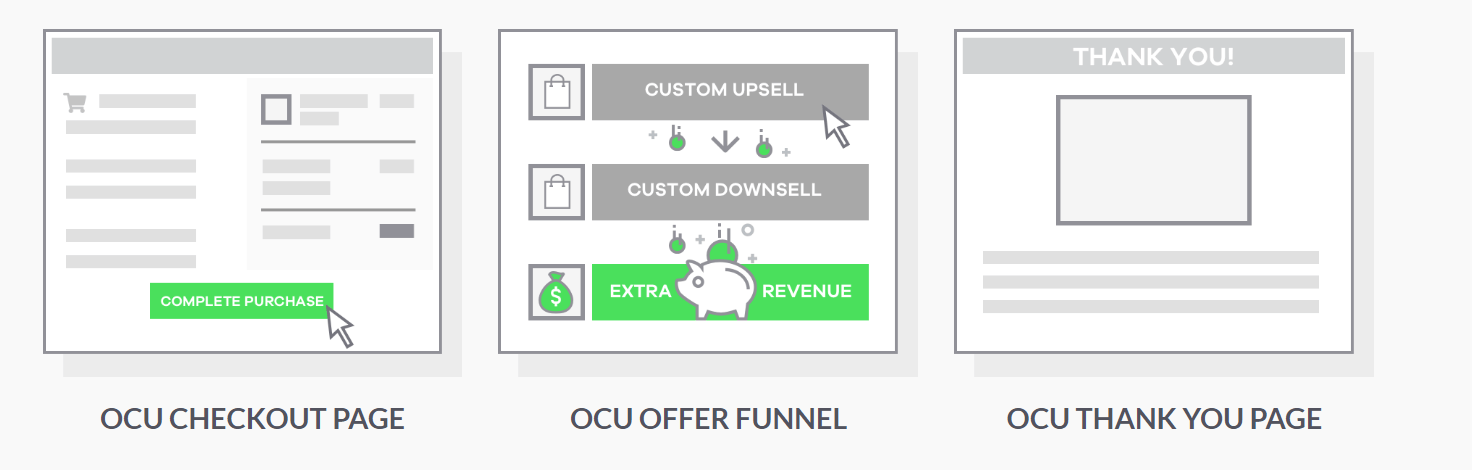
Zipify’s OneClickUpsell lets you create custom upsell and downsell offer pages that are shown to customers after they have already added a product to their cart and entered the payment details. The company claims to increase your revenue by 10-15% instantly, but at $47 a month, is it really worth it? Let’s find out.

About Zipify

Founded by Ezra Firestone, Zipify is a Shopify application that claims to have more than a thousand customers. It has a remote team working from multiple countries and the company offers two main products to Shopify users:

  • Zipify Pages: Helps users build visually appealing landing pages
  • Zipify One ClickUpSell: Allows users to create upsell or downsell offer pages

The company claims that after adding Zipify to their Shopify stores, users have noticed an instance 10-15% increase in sales. Zipify has total orders worth more than $400 and has helped its users gain $26 million extra in revenue.  

Strengths and Weakness

Pros

  • Creates completely customizable upsell funnels with upsell and downsell offers
  • Allows you to create unlimited funnels
  • You can split test different offer products and page designs
  • Mobile optimized

Cons

  • No dedicated support
  • Doesn’t offer as many features as the other upsell applications
  • No priority support or plans for large enterprises making it only suitable for SMBs
  • No free trial (Though there is a 30-day money back guarantee)

Features

Zipify’s OneClickUpsell helps users create completely customized post-purchase upsell funnels for the products on their ecommerce website. The app offers an easy to use drag and drop editor through which you can create upsell or downsell pages quickly.

For each upsell funnel, you can create a sequence of upsell and downsell offer pages. Users can create multiple upsell funnels and every product can have its own unique funnel.

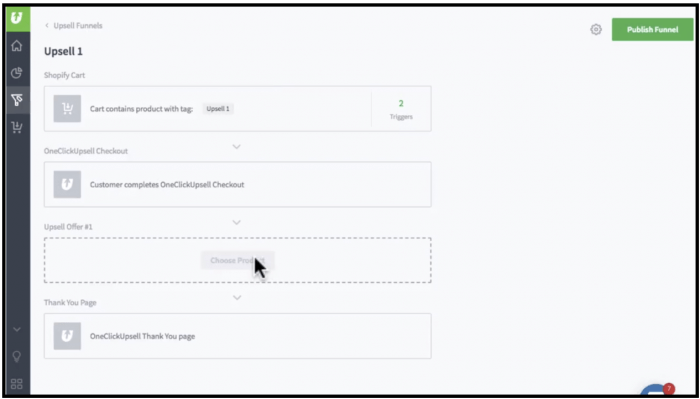
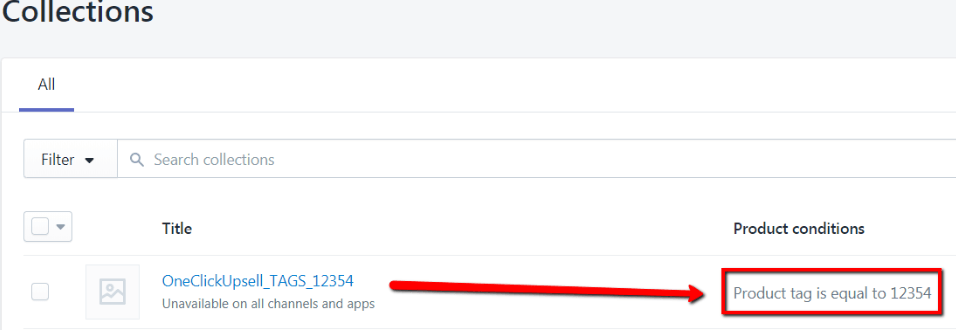
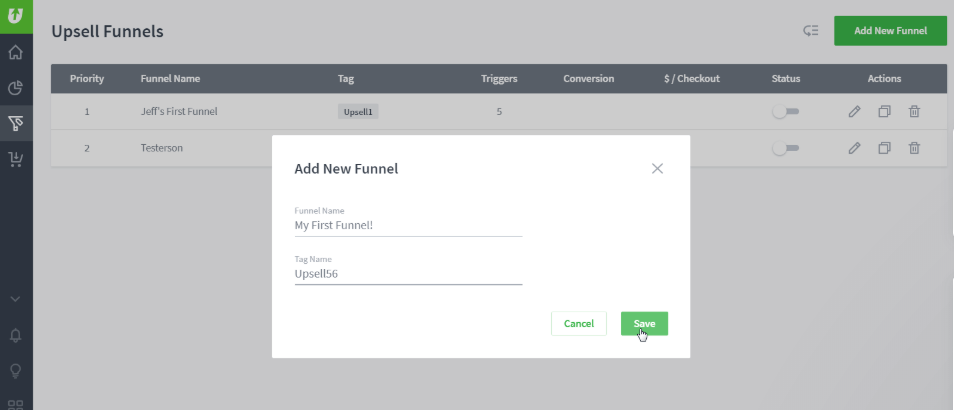
An upsell tag needs to be created for every funnel. This tag is then used to connect your store products to different funnels. The upsell funnels are added as hidden collections in Shopify and you can access them by going to Product → Collections in your Shopify admin.

After you create a funnel, you can add upsell or downsell offer products. You can either:

  • Create a new offer page
  • Copy an existing offer page

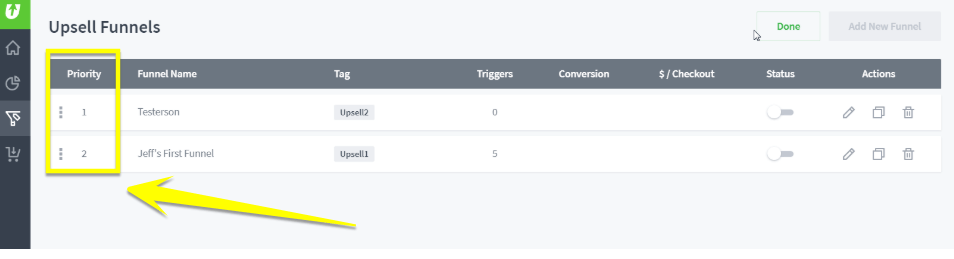
You can also change the order in which the offers are presented to the customers within an upsell funnel by changing the priority of each offer page. Funnel priority can be used when the cart contains products that trigger two or more funnels — The funnel with the highest priority will be triggered in that case.

For every upsell or downsell offer page, you can add customized title description and discounted costs. You can also change the colors of the offer pages to match your website theme.

Once the upsell page is created, you can link it to the main product that should trigger the upsell funnel by adding the respective upsell tag to the trigger page.

You can also disable or enable upsell funnels, depending on your requirements.

Zipify allows you to present a maximum of three upsell and two downsell offers to the customers.

The customer will be continuously presented with at most three upsell offers if they keep accepting the upsells. A downsell offer is only presented to the customers when they decline the first or the second upsell offer.

If the customer declines the first downsell, they will be taken to the second downsell offer and then to the order confirmation page.

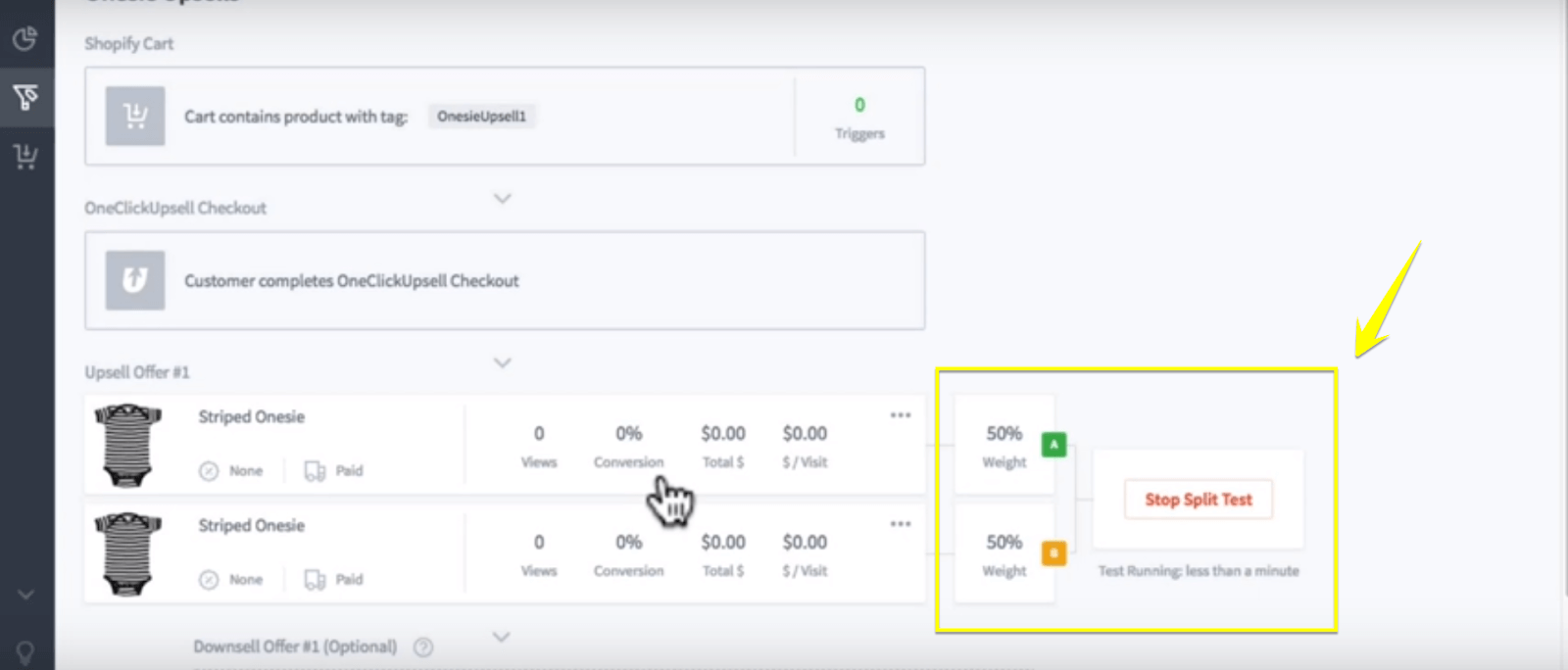
Zipify also allows you to split test the upsell and downsell offers that you have added to the upsell funnel. When you go on to create a split test, you will find two options:

  • Same product: With this, you can split test the same product against itself, but with a different page design to see which design performs better
  • Different product: With this option, you can split test different products in a particular upsell funnel position to analyze which one can return a higher conversion rate

As a bonus, you get also get an email sequence to increase sales even further when you buy a subscription to OneClickUpsell. Its a set of five emails that you can initiate when a customer abandons the cart. The Zipify OCU also works seamlessly with Clickfunnels as well.

Pricing

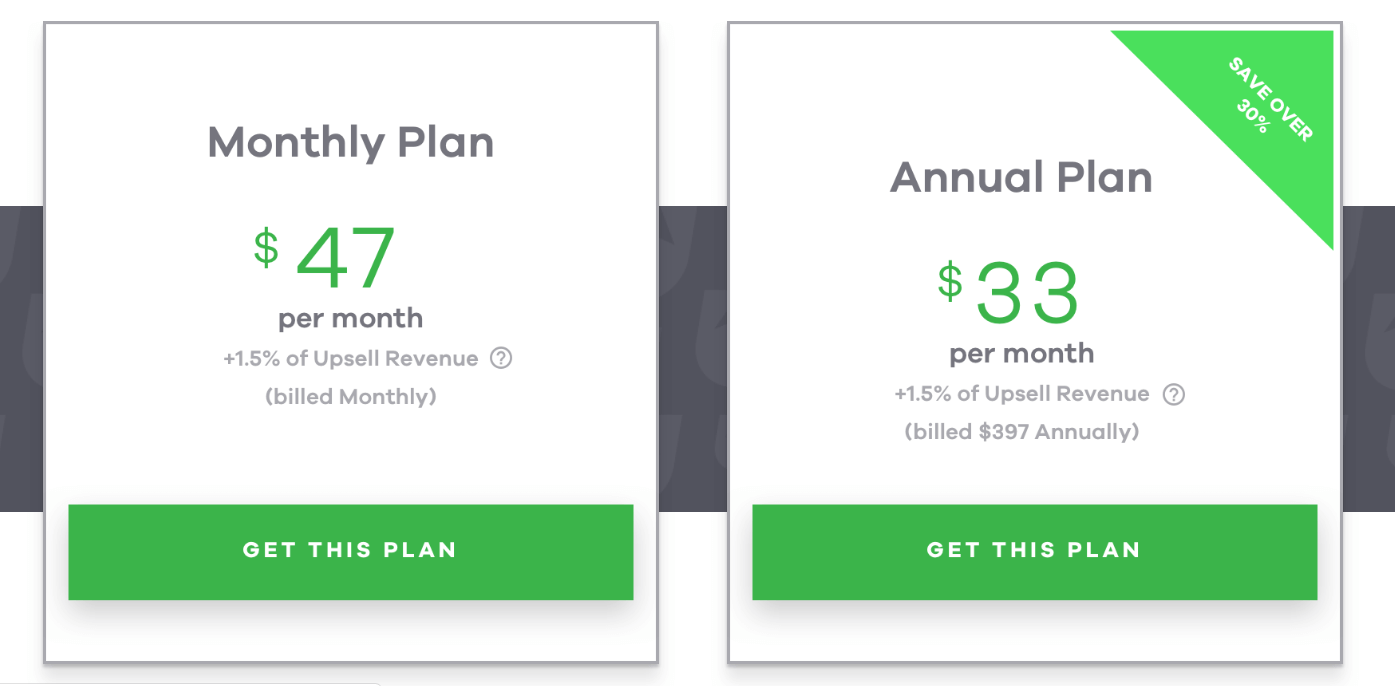
Zipify’s OneClickUpsell has a monthly plan and an annual plan. The monthly plan costs $47, while the annual plan costs $397 for a year (which comes down to about $33 per month). Apart from the fixed subscription charge, Zipify also takes 1.5% of the total upsell revenue.

There are no free trials available. You are charged right when you select a plan and enter your payment details. Though, the company does offer a 30-day money back guarantee.

While the costs are more affordable than the other upsell tools available online, a free trial, even for a few days would have been better as customers could get some time to try out the tool and see if it fits their business needs.

Integration

OneClickUpsell integrates seamlessly with all the major ecommerce applications including Stripe, PayPal, Authorize.net, MailChimp, Klaviyo, and Active Campaign

Support

Zipify has a help center with tutorials and documentation about OneClickUpsell. You can also directly email the company or send them a message through the live chat popup available on their website. Though Zipify does not specify anywhere about their response time.

In fact, the company explicitly states that in their Terms of Services as well. While they try to get back to their customers within one day, they do not guarantee or promise any specific response time. Zipify also doesn’t guarantee uptime.  

Final Verdict

Zipify is a great start tool for small to medium Shopify users who want to try out upsell pages on their website. It is affordable than many of the other upsell tools. Though, with no priority support or advanced features, its not suitable for large ecommerce stores.

The post Zipify One Click Upsell Review appeared first on Facebook Advertising Agency | Facebook Marketing Company.


from
https://voymedia.com/zipify-one-click-upsell-review/

5 Differences Between Quality Assurance and Quality Control

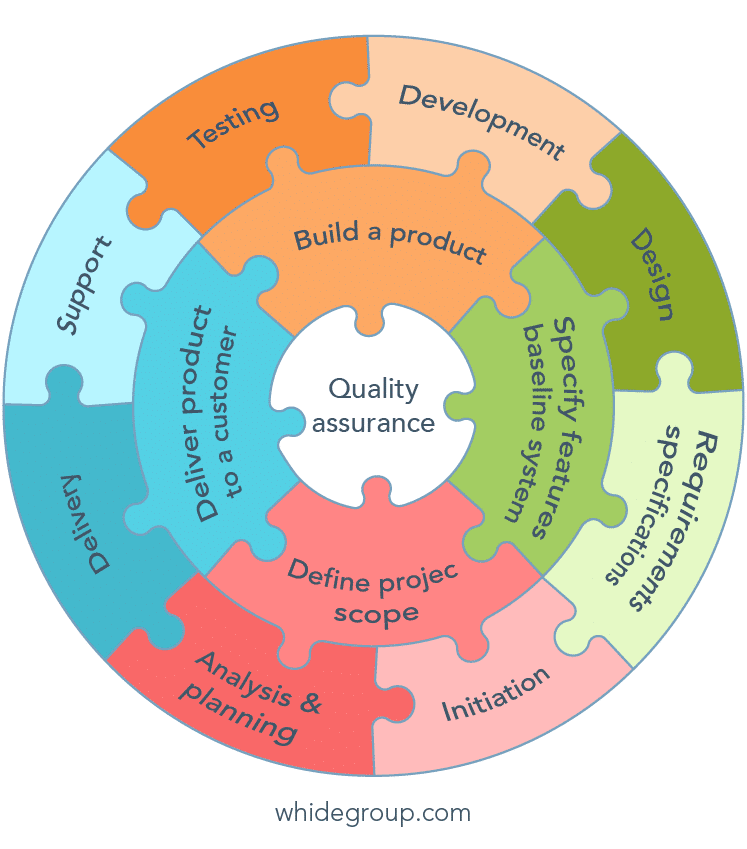
From the very first day of their creation, “quality assurance” (QA) and “quality control” (QC) terms have often been confused. As a company deeply interested in providing only top-notch website quality assurance services, Whidegroup knows a lot about every little aspect of quality when it comes to the development sphere, and can tell you the difference between quality assurance and quality control. So, let’s examine the details!

Introduction

It is a good idea to address QA and QC standards in order to determine what “quality” is. International Organization for Standardization (ISO) 9001:2015 Quality Management Systems – fundamentals and vocabulary state the following: quality is the degree to which a set of inherent characteristics of an object fulfills requirements. In simplest terms, quality means meeting customer requirements.

If we talk specifically from within the development sphere, the definition of quality remains virtually the same – quality is a set of features of the software that are related to its ability to satisfy established and perceived needs, according to (ISO) 8402:1994 Quality Management and Quality Assurance.

Both QA and QC are used to ensure the all-around quality of a product. Let’s take a closer look at them.

Quality Assurance: Strategy for Prevention

Quality assurance is a testing procedure that is a part of quality management. Quality assurance narrowly focuses on providing confidence in the fact that quality requirements are fulfilled. The confidence provided this quality management procedure is two-fold – internal to management and external to customers and third parties.


The quality assurance process is a proactive management practice. As a rule, QA testing is a manual process carried out by a separate specialist or team.

Functions:

  • Strategic planning – This function is responsible for enhancing the quality of products, as well as setting and disseminating biannual quality targets.
  • Organization – This function assigns a corporate officer to be in charge of QA, organizes Quality Review Meetings, and establishes and manages organizations to promote quality assurance.
  • Education – This function educates all employees about quality with an eye toward improving their problem-solving skills through specialized trainings.
  • Standardization – This function establishes common rules, and organizes, maintains, and improves the business standards for each business or the product characteristics.
  • Settlement – This function confirms whether the work process is established within the product providing organization and evaluates its conformity to the Quality Assurance Program.

Focuses:

  • Verifying the declared level of quality for a particular product.
  • Identifying process improvement areas.

Quality Control: Strategy for the Detection

Quality control is described as a process by which entities review the quality of all factors involved in production. ISO 9000 defines QC as “a part of the quality management which focuses on fulfilling quality requirements.” Or, in a nutshell, QC is the part of quality management which focuses on meeting definite quality requirements on the very final stage of the production.

The main aim of the quality control process is verification of output conformance to the desired quality level. This means that the ready solution is checked against every customer requirement, on a strict plan, over specific points in the development lifecycle. Amongst other techniques, engaged teams use structured walkthroughs, testing tools, and code reviews to make sure that the solution meets the predefined set of requirements.

Functions:

  • Testing – QC specialists perform quality control tests for services provided, as well as evaluating the quality of a specific service at specified intervals throughout the time of service. Testing provides quality results as of the date of testing.
  • Monitoring – this function consists of ongoing testing that the quality control specialist performs on a regular basis. The specialist repeats the testing and records the results of each test.
  • Auditing – the QC specialist reviews the results reported by the regular quality control workers to determine if they performed the original tests correctly.
  • Reporting – periodically, the QC specialist reports the quality results to management. A high number of quality problems means something is wrong with the process and the company may then be expecting many unhappy customers.

Focuses:

  • The readiness of the software for its release
  • Compliance with the declared requirements
  • Compliance with the declared quality of the product

Understanding the Difference

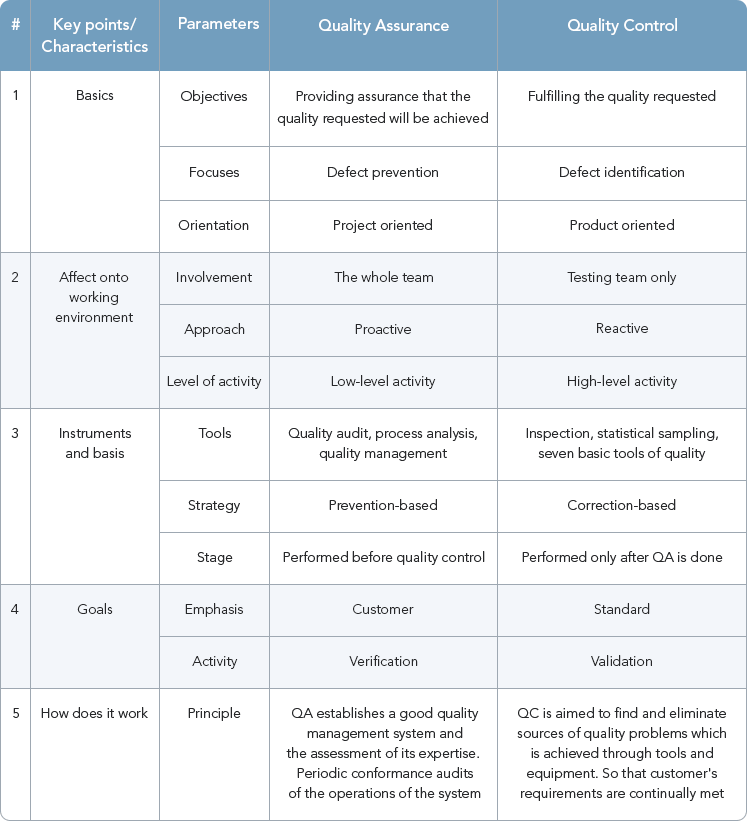
So, we’ve reviewed both quality assurance and quality control. Now it’s time to learn the differences between these two terms, distinguish the advantages and disadvantages, and make a comparison. In order to simplify this process, we’ve prepared a comparison table. So, let’s begin.

As you can see, it’s absolutely impossible to answer the question “QA or QC: which is best?” – even after thorough quality control and quality assurance comparison. They are both two sides of the same coin, but combining them wisely can bring you success and profits.

It’s difficult to overestimate the effectiveness of such a complex and structured quality management approach with QA and QC both at the helm. The benefits of such a powerful dual application lay on the surface:

  • Providing a high-quality output – since both QA and QC are closely related to each other, their objectives are similar: to deliver a defect-free service or product.
  • Increased efficiency of operations and waste management.
  • High level of confidence and a motivated team.
  • Less rework and after-sale support are required, which help you to save funds!
  • A higher level of customer satisfaction, which will very likely result in repeat business, as well as referral business.

We aspire to provide top-level services, which is why we’re aware of both the peculiarities and the benefits, of quality assurance. We can say the same about the features and advantages of quality control. Still not sure about what exactly do you need for your project? If you need qualified assistance with either of these two – you can count on us.

The post 5 Differences Between Quality Assurance and Quality Control appeared first on Facebook Advertising Agency | Facebook Marketing Company.


from
https://voymedia.com/5-differences-between-quality-assurance-and-quality-control/

Here are 6 Ideas to keep your Digital Marketing Clients longer

The marketing landscape has transformed significantly in the past few years. Now, digital marketing has become an essential part of the field. Building a sound brand image now pertains to being favorably represented online and offline. In fact, 72 percent of marketers find content marketing to be the most effective form of SEO.

As a digital marketing agency, one thing is for sure- you will get a lot of digital marketing clients. However, the key is not just to attract them and get them onboard. Instead, you must also retain them in the long-run as well.

Here are six ideas that will aid you in keeping your digital marketing clients longer.

  1. Have clear values

Customers to today, even if they are businesses, are not just interested in your service. Instead, they care about your values and how well they align with their values. In fact, a study was conducted by the Corporate Executive Board showed that 64 percent of customers want shared values with the companies they partner with. Therefore, if you want to retain customers in the long-run, make sure that you stand for something. And stand for something meaningful and valuable to society. Being just another digital agency Atlanta has to offer won’t cut the deal.

  1. Keep up with digital marketing trends

Source

Digital marketing is ever-fleeting. The best practices of today might not be applicable tomorrow. This means that as a digital marketing agency, you need to keep up with the changing landscape. Make sure that the marketers you have onboard are aware of the changing digital platform. Keep up with SEO practices and deliver quality services to your customers in the long-run. By making sure that you know what digital strategies are in, you can ensure consistent services to your clients.

  1. Be friendly

As a digital marketing expert, you will be in close contact with your customers. Whenever you communicate with them, you must be at your best behavior. Make sure to be friendly and helpful. Listen carefully to their problems and show that you are concerned. Customers are more tempted to stay with companies that have friendly representatives than ones where they don’t feel appreciated.

  1. Focus on quality rather than speed

Sometimes trying to deliver results quickly is not the way to go. While it may allow you to retain customers in the short-run, it may become counterintuitive in the future. Why is this so? Well, this is because, generally the more quickly you offer results, the more fleeting they are in the world of digital marketing. This occurs because rather than treating the underlying problem, you focus on addressing the symptom. Rather than focusing on speed of service, try to focus on the quality instead. It doesn’t hurt to take your time. Let your clients know from the beginning that stable and lasting results can’t be achieved overnight. Work to provide long-term value to your clients.

  1. Customize your digital marketing services

Source

As a digital marketing firm, some of you might consider standardizing your service. While it may work in other sectors, digital marketing is one field that has no room for standardized services. This is because every organization has varying needs and faces different challenges. And hence, they require customized solutions. Standard services might work initially to deliver essential services. However, to get a high SERP for instance, you need to alter your strategies than to rectify the issues faced by the organization. Customers like organizations that delve deep into their problems. They are more likely to stay with them long-run because this act helps in building trust.

  1. Be transparent

Transparency is one of the essential characteristics of any digital firm. It helps in establishing trust with your digital marketing clients. Rather than exaggerating the numbers or being ambiguous about a firm’s online performance following your campaign, try to be as transparent as possible. Keeping your client in the loop is just as important as delivering quality marketing services to them. You can be providing excellent ROI to your client, but unless they about it, they won’t be able to appreciate your service fully.

Conclusion

These are just six of the various ways you can keep your digital marketing clients with you for a longer time. At the end of the day, what truly matters most is what your clients are getting out of your service and association. By continuously improving your services to incorporate recent trends, being transparent and friendly, you will be able to retain your clients.

Have the right goals in mind as a digital marketing provider. Adopt a customer-centric approach and watch as your client bounce rate decrease substantially.  We live in a world where digital solutions are becoming increasingly popular. Leverage it now to get a significant mind share.

The post Here are 6 Ideas to keep your Digital Marketing Clients longer appeared first on Facebook Advertising Agency | Facebook Marketing Company.


from
https://voymedia.com/here-are-6-ideas-to-keep-your-digital-marketing-clients-longer/

How to Create an Impactful Presence through Advertisement on Social Media

As a matter of fact, while addressing advertisement through the medium of Social Media there is a key advantage that requires acknowledgment. Which is from day one you begin to receive a response. That’s how strong the influence of Social Media is in the current era. Businesses can grow over a period of time by utilizing added facilities in the best possible ways. To divert the attention of the audience towards Search Engine Optimization strategies redefining the viewers created by the advertisement. Well, that is also the primary very reason why, even though they are dozens of marketing strategies Social Media Advertising is one of the top-notch strategies to opt for that delivers results instantaneously.

Social Media platforms are used due to the few very simple logics. Such as its addresses a mass audience, the advertisement development maybe expensive but the acquisition cost is lower comparatively and that it provides a huge increase in the conversions into sales via these ads. Currently, due to these demands the Android and iPhone app development company around the globe have started introducing newer features and supporting in a more advanced manner for the better and vibrant presence of brand advertisements on various Social Media according to their trends. The most benefiting and impactful results are produced when the correct targeted market aligns with the appropriate user demographic of the Social Media platform where the results are spectacular.

  • Build Strong Brand Awareness

In order to create strong brand awareness, Social Media is a great asset but for the advertisement to stand out it is essential that the produced content that is shared on Social Media has a uniqueness and charm to make a place and get set in the mind of the viewers. The presence of the brand will increase as the top trending or product is amplified in terms to create a higher demand and promotion to gain followers. By enhancing the features of the advertisement when sharing on Social Media with filters applied on the behavior and demographics of your audience by targeting the correct oriented market and increasing it while having a substantial hold of a vibrant presence on your advertisement achieving remarketing ahead. As an accelerant factor due to the use of a correct method of ads presented on Social Media an even larger traffic explosion occurs carrying a win-win situation at every end.

  • Engage with the Masses

Well, the relevance of engaging with the masses is crucial to be able to attract Social Media users towards the advertisement. The correct use of keyword targeting ensures the perspective to convert an average advertisement into a unicorns immerging excellence in terms of the presence and connection of the ads with the audience regardless. The presence of the shared ads should be in such a unique or informative format that the viewers are fixated or then the message is vividly presented to create a drive for the product. It is also an interesting manner or rather a relatively better manner to engage with the masses due to the goal aching facility that comes with it and also for the fact that Social Media is feasible as well. Features according to the relevance can be paid for on Social Media advertising so that the best results are gained even while a connections to publicize the website with other goods can be accomplished. Mentions, retweets, share, comments, etc. each such feature adds up to the overall strength of Social Media Advertisement preference.

  • Ads that gain the Popularity

The advertisements that gains hype through Social Media are those which carry out each and every factor that is by improving the Quality Score of the posts and by a continuous increase in post engagement rate. Focus on advertising to the correct targeted audience to invest correctly. Obtain the most potential possible via generated free clicks from paid ads and by making your video ads memorable by the key features highlighted in a short eyes glazing experience. Gain the most popularity as possible with the feature of Custom Audiences that will endorse a more impacting identity-based marketing that will prevail as a longer presence impacting to the audience. It will help in creating and captivating masses when able to gain the attention of combining every aspect with super remarketing tactics and updates conducted regularly of the advertisement. Staying tuned with the market as well as the feedbacks gained on Social Media to improvise accordingly is crucial in terms to audience satisfaction and popularity.

The post How to Create an Impactful Presence through Advertisement on Social Media appeared first on Facebook Advertising Agency | Facebook Marketing Company.


from
https://voymedia.com/how-to-create-an-impactful-presence-through-advertisement-on-social-media/